Closing Shift at Marlowe’s
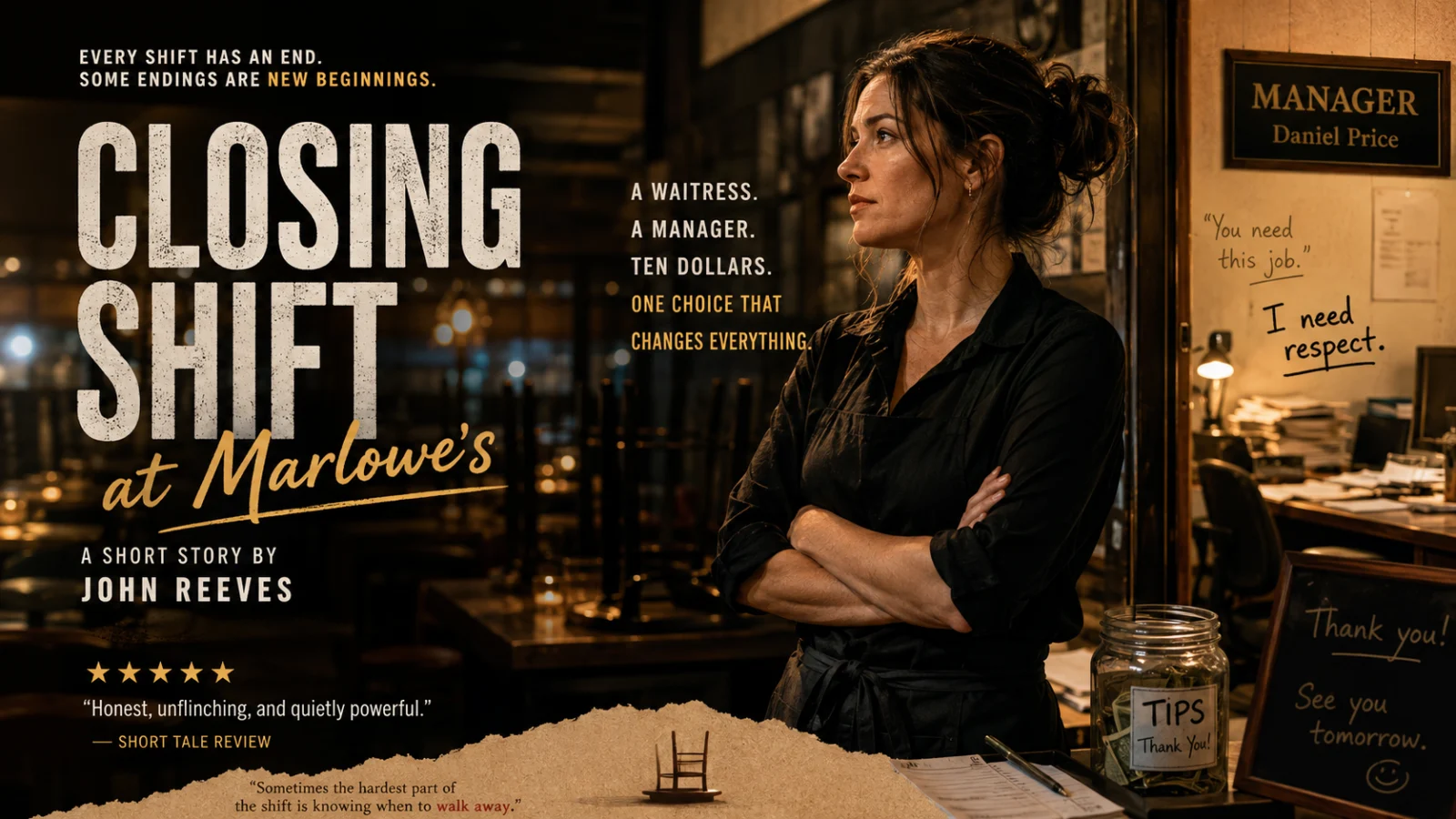
By the height of the Friday dinner rush, Rebecca Shaw had apologized for a delay she had not caused, replaced two steaks that had waited too long under the kitchen lights, and lost the same pen twice. Marlowe’s measured a good night by how many small failures reached the staff before they reached the customers.
Rebecca had worked in restaurants for nearly twenty years. She remembered regular orders, noticed anniversaries before anyone mentioned them, and could tell when a table wanted conversation or only wanted its check. She still liked the work. What tired her was the steady transfer of every mistake toward the person standing nearest the customer.
Daniel Price found her at the service station while she waited for two entrées. He held a receipt in one hand and spoke quietly, making her lean closer while the dining room carried on around them.
“Table Nine wants the weekend promotion.”
“It starts tomorrow.”
“I know.”
The date appeared on the menu and on the advertisement beside the entrance. Rebecca had already shown both to the customer.
“Take ten dollars off anyway,” Daniel said.
“The register won’t allow it.”
“Then take it out of your tips.”
Rebecca set down the tray she had been holding. Restaurants absorbed larger losses than ten dollars every week: a meal sent back after most of it had been eaten, a drink removed because the wait felt too long, a dessert offered before an online complaint appeared. Those decisions belonged to the business.
“You want me to pay for a promotion that doesn’t exist?”
Daniel looked toward Table Nine. “Customers remember how they felt long after they forget a receipt.”
“Then Marlowe’s can pay for the feeling.”
His expression barely changed. He folded the receipt once. “We’ll finish this after closing.”
The exchange took less than two minutes. Rebecca carried plates, refilled coffee, and wrapped leftovers while noticing Daniel in different parts of the room. He was not checking her tables. He was waiting for the shift to end.
Frank Mercer noticed something too. He occupied his usual Friday table near the back wall, where he read the paper beside a cup of coffee. He owned a small machine shop a few blocks away and had become memorable for the uncomplicated fact that he did not make a server’s night harder.
Rebecca filled his cup and reached for the bread plate.
“You look distracted,” Frank said.
“I’ve looked worse.”
“I didn’t ask that.”
She glanced toward Daniel. “Long night.”
Frank nodded, unfolded his newspaper, and did not ask for the rest. Rebecca appreciated the question ending where she had left it.
Closing came by degrees. One table lingered over dessert while another divided a check six ways. The cooks shut down equipment, chairs went upside down on tabletops, and the music dropped low enough for voices to carry across the room. Rebecca counted her tips at the register. She separated ten dollars, stared at it, and returned it to the stack before Daniel asked her into the office.
The room barely held two people comfortably. A crowded desk sat between dented filing cabinets, the schedule hung crooked on the wall, and a security monitor displayed dining rooms emptied of customers.
Daniel closed the door. He said Rebecca had embarrassed him in front of the staff, questioned management, and become difficult over the past several months. She listened until he placed the folded receipt on the desk.
“It’s ten dollars,” he said.
Rebecca opened the receipt and looked again at the promotion date. “Then the restaurant can afford it.”
“This isn’t about whether the restaurant can afford ten dollars.”
“No. It’s about whether you can make me pay it.”
The dishwasher struck the metal sink beyond the wall. Someone in the kitchen laughed and then lowered their voice.
Daniel leaned against the desk. “You have a son. You have bills. You have a schedule full of shifts you probably can’t afford to lose.”
Rebecca thought of Tyler’s schoolbooks across the kitchen table and of the next rent payment, though she did not know what would replace the shifts pinned to the wall. Daniel was counting on the same uncertainty. That was what made the sentence useful to him.
She untied her apron, folded it, and placed it beside the receipt.
“I’ll save you ten dollars,” she said. “Find someone else.”
For the first time that night, Daniel looked surprised.
Outside the office, nothing stopped. Carla pushed Rebecca’s tip envelope across the counter and went back to the espresso machine. Marcus lifted one hand from the dish station without leaving the sink. A line cook wrapped two untouched slices of pie in foil and set them beside Rebecca’s bag because they would be thrown away before morning.
Rebecca thanked the people still working and crossed the parking lot with the pie beneath one arm. She did not look back to see whether Daniel had left the office.
Tyler was awake when she reached the apartment. His schoolbooks covered half the kitchen table, and a fan hummed in the corner because the old heating system seemed unable to decide whether autumn had arrived. Rebecca placed the pie between them.
Tyler looked at the box and then at her. “You got fired?”
“I quit.”
“Tonight?”
Rebecca cut the pie into two uneven pieces and gave him the larger one. She explained the promotion, the receipt, and Daniel’s office. Tyler interrupted only to ask whether Daniel could legally take the money and whether she had another shift somewhere else.
“No other shift,” Rebecca said.
He opened his backpack and took out a part-time job application he had planned to mention over the weekend. He left it on the table without pushing it toward her.
“I was going to ask if this was okay.”
Rebecca read the first line and returned the paper. “If you want the job, take it.”
“What if we need the money?”
“We’ll figure that out after you decide whether you want to work there.”
Tyler folded the application once. Neither of them pretended that answered the question.
The next morning, Rebecca printed several copies of her résumé and drove from one restaurant to another. Managers thanked her for stopping, promised to keep the paper on file, or said they had just finished seasonal hiring. By early afternoon, she had collected enough polite smiles to know none of them was an offer.
At a gas station, she reached into her wallet for a credit card and found Frank Mercer’s business card behind her driver’s license. He had left it in a check holder weeks earlier. Rebecca had placed it in her wallet without asking why.
Mercer Precision Works occupied an aging brick building beside a freight yard. Rebecca sat in the parking lot long enough to consider leaving. Before she could shift into reverse, Frank saw her through the office window and came outside carrying a coffee mug.
“I hoped you’d stop by,” he said.
“I’ve never worked anywhere like this.”
“I noticed.”
He unlocked the office and showed her the reason for the card. Invoices shared desk space with shipping forms, supplier catalogs, handwritten notes, and unopened envelopes. The phone rang while they stood there. Frank looked at it until the caller gave up.
“My office manager retired last month,” he said. “I’ve been pretending I can replace her.”
Rebecca picked up the nearest stack. Purchase orders from different months had been clipped together. Invoices sat inside payroll folders. Delivery dates had been written on the backs of coffee-stained napkins.
“How far behind are you?” she asked.
Frank looked at the desk. “I stopped counting when that seemed safer.”
The phone began ringing again.
Rebecca did not ask what the job paid. Frank had not offered her one. She set down the stack, opened the top drawer of the filing cabinet, and reached for the first folder.