Thomas Reed, Off the Clock
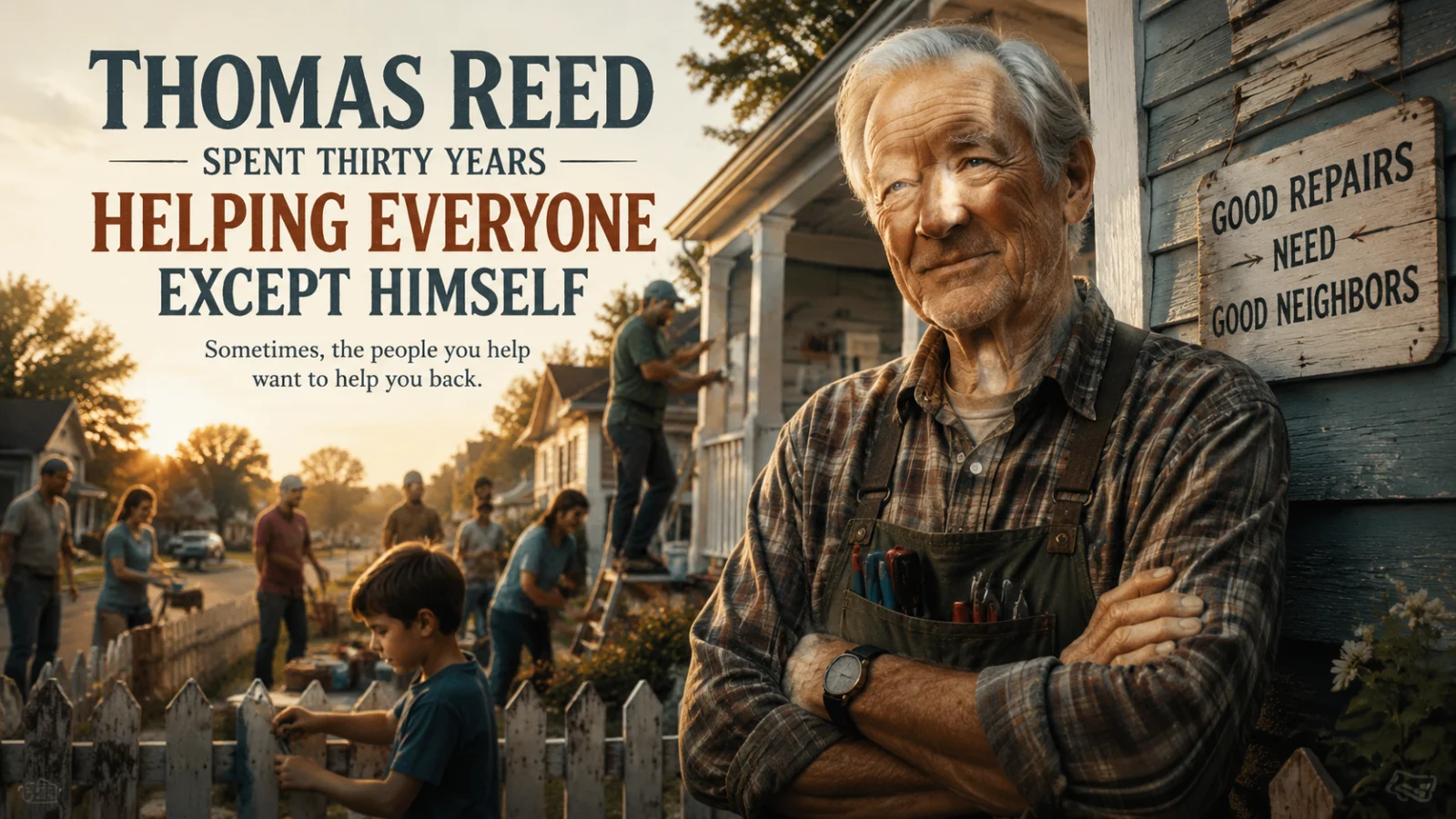
For nearly thirty years, people in Millbrook called Thomas Reed when a door dragged, a porch step shifted, or a fence began leaning toward the street. He had no business sign and did not advertise. He carried an old green toolbox, arrived when he said he would, and usually refused payment.
“Help somebody else when you can,” he told people.
It sounded generous because it was. It also ended the discussion on Thomas’s terms.
At seventy-one, Thomas lived alone in a small blue house at the end of Willow Street. The porch paint had faded, one section of fence leaned toward the sidewalk, and the front door stuck during humid weather. Neighbors joked that Thomas could repair every house in Millbrook except his own.
“It still works,” he said whenever someone pointed at the door.
The answer covered more than the door.
Thomas had learned repairs from his father, a carpenter who took him from one job to another. As a boy, Thomas learned to measure twice, keep a hand behind a saw blade, and understand that a loose step mattered more to the person who climbed it every day than it did to anyone driving past.
His father once told him that a home was more than walls and a roof. It was where people needed to feel safe after a difficult day. Thomas remembered the sentence and rarely repeated it. He preferred a repaired hinge to an explanation.
Years later, Sarah Mitchell moved to Millbrook with her eight-year-old son, Noah. She had accepted a nursing position at the local hospital and rented an older house because it was close to work and within her budget. The kitchen cabinet doors would not close properly, the back steps shifted under weight, and the front door needed an extra shove before the lock aligned.
Sarah made a list and put it in a drawer. The problems were manageable one at a time and expensive when considered together.
One evening, Thomas passed while she stood at the front door holding a screwdriver.
“You look like you’re trying to negotiate with it,” he said.
“The door has better terms.”
Thomas set down the green toolbox and checked the hinge. Sarah asked what he charged.
“Coffee someday.”
“That isn’t a price.”
“It’s the one I gave you.”
Before Sarah could decide whether accepting was rude, Thomas had described the damaged hinge and the frame pulling out of alignment. The next morning, the door opened without resistance. He had adjusted the frame, replaced the hinge, and repaired the lock.
Sarah brought him coffee that afternoon. Thomas accepted it only after reminding her he had said someday, not the next day.
Over the following months, he became familiar to Sarah and Noah. He helped Noah repair an old bicycle and showed him how to build a birdhouse for school. Thomas answered questions seriously, but he did not rescue Noah from mistakes. If Noah confused two measurements, Thomas held the board and waited until he checked again.
Noah began inspecting repairs even when nobody had asked him to. One afternoon, walking past Thomas’s house, he stopped at the leaning fence.
“That post is worse than ours was.”
Thomas looked at it. “Probably.”
“Why don’t you fix it?”
“I’ve been busy.”
Noah pointed toward the porch. “And the paint?”
“Also busy.”
“But you fix everybody else’s houses.”
Thomas rested one hand on the toolbox. “Some things are easier to ignore when they belong to you.”
Noah accepted the answer long enough to repeat it to Sarah.
She had noticed the house, but she had treated its condition as Thomas’s preference. The sentence made her consider a different possibility: everyone knew how to ask Thomas for help, and nobody had developed a way to offer it that he could not dismiss.
Sarah began calling people he had helped. She contacted families whose doors or steps he had repaired, older residents who remembered him arriving with the green toolbox, and neighbors who had accepted his refusal to be paid. Some people could not come on the same day. Others offered tools or materials. Sarah assigned nothing until she knew who was actually available.
The following Saturday morning, Thomas opened his front door and found several people outside with paint supplies, gardening tools, and wood for the fence.
He looked from the supplies to Sarah. “What did you do?”
“Made some calls.”
“The house is fine.”
Noah pushed the front door. It stuck before opening fully.
Thomas frowned at him. “Humidity.”
“It’s not humid,” Noah said.
Thomas tried the usual objections. People had their own work. The porch could wait. The fence still stood. Nobody needed to spend a Saturday fixing problems that were not urgent.
Sarah let him finish. “You don’t have to like it.”
“That’s convenient.”
“You taught everyone here that.”
The work began before Thomas agreed that it had begun. One group scraped loose paint from the porch. Another removed damaged fence boards and checked the posts. Someone took the front door off its hinges while Thomas stood beside the empty frame looking as though the house had been left open on purpose.
For once, he was not directing the whole repair. He still tried. He corrected a measurement from several feet away, suggested a different order for the fence boards, and took a brush from someone’s hand to demonstrate how much paint it should hold.
“You can sit down,” Sarah told him.
“I live here.”
“That’s not the same as being in charge of every brush.”
Thomas returned the brush. Ten minutes later, he was explaining the door frame to someone who had not asked.
The residents did not perform every task the way Thomas would have. One fence board had to be removed and cut again. Paint reached a section of trim scheduled for later, and Thomas spent several minutes deciding whether to object. His knowledge remained useful, but usefulness was different from ownership.
By evening, the fence stood straight, the porch had fresh paint, and the front door opened without resistance. Thomas tested it three times. On the third, Sarah asked whether he planned to wear out the new adjustment.
They sat on the porch with coffee after the tools were put away. People mentioned repairs Thomas remembered and others he did not. The stories stayed short because everyone was tired. Nobody asked Thomas to respond to them.
A month later, Noah brought him a wooden sign. The letters were uneven, and blue paint had crossed one edge of the board.
`Good repairs need good neighbors.`
Thomas turned it over and checked how the hanging wire had been attached.
“You missed the words,” Noah said.
“I read the words.”
“And?”
Thomas looked at the uneven letters again. “The wire will hold.”
He hung the sign above the workshop door.
Thomas continued carrying his toolbox through Millbrook. He repaired doors, fixed fences, and answered calls. He still resisted payment, and he did not become comfortable asking for help simply because one Saturday had ended well.
The following spring, a storm damaged several boards on his fence. Thomas walked the length of it with the green toolbox, removed one loose board, and stopped at the next post. The repair required more hands than he wanted to admit.
He went inside and called Sarah.
“Do you know anyone who can help me replace a few boards?”
There was a pause on the line, short enough that Thomas could pretend she was checking her schedule.
“I know a few people,” Sarah said.
That afternoon, Thomas placed the toolbox on the porch and unlocked the gate before his neighbors arrived.