Saturday Receipts
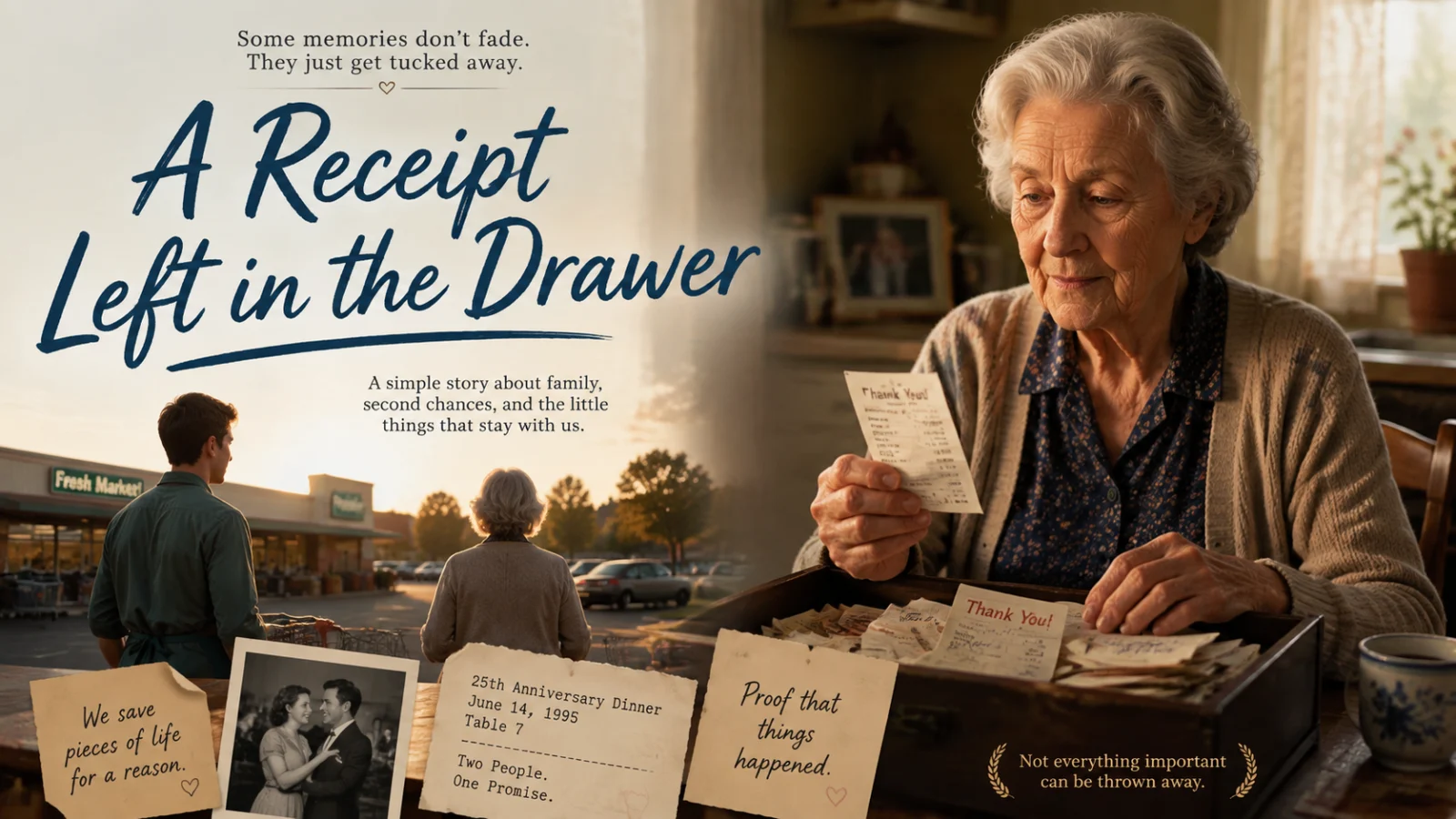
Martha Collins kept receipts folded into quarters in the kitchen drawer, wedged between batteries that might still work and coupons from stores that had closed. When the drawer jammed, she pushed it shut with her hip. When Emily suggested throwing something away, Martha said, “I like proof.”
“Proof of what?” her daughter had asked once.
“That things happened.”
At seventy-two, Martha lived alone in a small blue house outside Columbus. The porch needed paint, one kitchen cabinet hung lower than the others, and the backyard fence leaned toward the neighbor’s yard after years of storms. She knew which hallway board cracked beneath her foot and which window needed an extra push before the lock caught. The stairs had become harder on her knees, but she took them slowly and disliked being watched while she did it.
Daniel had repaired most of the house himself. He was an accountant, not a carpenter, but he trusted patience, a toolbox, and repeated trips to the hardware store. Sometimes a repair lasted twenty years. Sometimes Martha spent a Saturday holding a flashlight while he discovered that the part he had bought did not fit.
“We could have replaced it,” she would say.
“Then what would I do with the part?”
The question made sense only to Daniel.
He had been dead eight years. His pencil marks remained inside the cabinet under the sink, and a pale paint stain crossed the garage floor from the weekend they painted the living room themselves. His coffee mug with the cracked handle sat at the back of a shelf. Martha did not use it, but she noticed whenever Emily moved it.
People suggested selling the house and moving somewhere easier. Martha understood the arithmetic: an old heating system, a roof already repaired twice, stairs that would not become kinder. What she disliked was the speed with which a life could become a list of defects.
Every Saturday morning, Martha drove three miles to the same grocery store. She bought the same coffee, bread, and apples and parked near the entrance so she would not have to carry the bags across the lot. Noah usually worked the first register. He was nineteen, studied business at the local community college, and worked mornings to help cover his expenses.
Their conversations had started with school and weather. Noah was polite, but Martha liked that he did not pretend college was exciting when “expensive” was the more accurate word.
One Saturday, she noticed the dark crescents beneath his eyes.
“Are you sleeping?” she asked.
“Sometimes.”
“That’s not an answer.”
“It’s the answer I’ve got.”
The customer behind Martha shifted a basket from one hand to the other. Noah glanced toward the growing line. Martha put her card into the reader and left without asking another question.
Emily arrived that afternoon carrying two coffees and the serious expression Martha recognized from every conversation about the house. She had spoken with a contractor. The roof, plumbing, and heating system all needed attention, and the likely cost was higher than either of them wanted.
“Nobody has inspected anything,” Martha said.
“Not yet.”
“Then we don’t have a cost. We have a guess.”
Emily set down her coffee. “Let him inspect it.”
Martha looked toward the cabinet beneath the sink. Daniel had rehung the door after the bottom warped, and it still closed squarely.
“The heat works,” she said.
“I’m not asking you to move tomorrow.”
“You keep saying tomorrow as if the rest of the sentence isn’t coming.”
Emily was quiet for a moment. “I’m asking what happens a few years from now.”
Martha told her she was doing fine. Emily said she knew, then added that her mother had spent her whole life handling things alone. Martha heard the concern in it. She also heard a decision gathering shape before she had made one.
That evening, she opened the kitchen drawer and spread several receipts across the table. There was one from the restaurant where she and Daniel celebrated their twenty-fifth anniversary, another from the hardware store that sold them the living-room paint, and one from the hospital cafeteria on the day he died. The ink on that one had faded to a few gray numbers and part of a word.
Martha held it for a moment, refolded it, and returned every receipt to the drawer.
Noah was not at the store the following Saturday. He was gone the next week too. After several weeks, Martha asked another cashier and learned that his mother had medical problems. Noah had left for a warehouse job with longer hours and better pay.
The next Saturday, Martha found him sitting outside the store with his phone in one hand. He was no longer wearing the store apron.
“You’re difficult to find,” she said.
Noah looked up. “I wasn’t aware you were looking.”
She sat at the other end of the low concrete wall, leaving room between them. Noah explained the warehouse job and his mother’s treatment. The pay was better, the shifts were longer, and he did not know how long he could keep managing everything.
“Are you eating properly?” Martha asked. “Sleeping?”
His mouth tightened. “Everyone asks what I’m doing to take care of myself. I know they mean well. It still sounds like one more thing I’m doing wrong.”
Martha watched a loose shopping cart roll until a woman caught it beside a parked car.
“You’re right,” she said.
Noah looked down at his phone. Martha opened her purse for a tissue and saw the hospital cafeteria receipt. She took it out and unfolded it on her knee.
“This is from the day my husband died.”
Noah glanced at the paper, then at her. “Why keep it?”
The old answer about proof came to mind, polished from use. Beside someone waiting through his mother’s treatment, it seemed to need fewer words.
“I bought coffee,” Martha said. “I don’t remember drinking it. I remember being angry that they charged me for it.”
Noah gave a short laugh and then looked embarrassed by it.
“It was terrible coffee,” she said.
They sat without trying to improve the afternoon. When Noah’s phone rang, he stood and walked several paces away to answer it. He returned only to say he had to leave. Martha did not ask who had called, and she put the receipt back in her purse.
A month later, Emily brought the contractor to the house. For nearly an hour he checked the roof, examined the pipes, and tested the heating system. When he finished, he said the repairs were manageable, although Martha would have to decide which mattered most.
In the kitchen, he opened the cabinet beneath the sink and paused at Daniel’s old repair.
“Who did this?”
“My husband. About twenty years ago.”
The contractor examined it and said the work was better than some professional repairs he had seen. Then he closed the cabinet and continued through the list. The compliment did not make the roof newer or the heating system cheaper. Martha had not expected it to.
After he left, Martha and Emily sat on the porch. Across the street, a neighbor watered flowers while children rode bicycles near the sidewalk.
“I made the house sound like a problem,” Emily said.
“It has problems.”
“That’s not the same thing.”
Martha looked at the contractor’s list. “We decide what matters first. We don’t decide everything.”
Emily nodded, but neither of them crossed the future off the page.
That evening, Martha emptied the receipts from the kitchen drawer and separated them into two groups. Some were too faded to read. Others still carried a place, a purchase, or a day she wanted to keep. She placed those in a small cardboard box beside the kitchen table and put the rest into an envelope for recycling.
The hospital cafeteria receipt went into the box. So did the restaurant receipt and the one from the hardware store. Martha closed the lid without counting them.
The next Saturday morning, she drove to the grocery store. Noah no longer worked there, but she saw him near the entrance wearing a different uniform. He said the new job was different from the old one, but the hours were better. Martha did not ask for more than he offered.
When he noticed the cardboard box on the passenger seat, he nodded toward it. “More proof?”
“Less of it.”
An elderly customer approached the entrance, and Noah stepped back to hold the door. Martha opened the car, lifted the box lid, and moved one receipt from the bottom to the top. Then she closed the lid, started the engine, and drove home.