What Eleanor Wrote Down
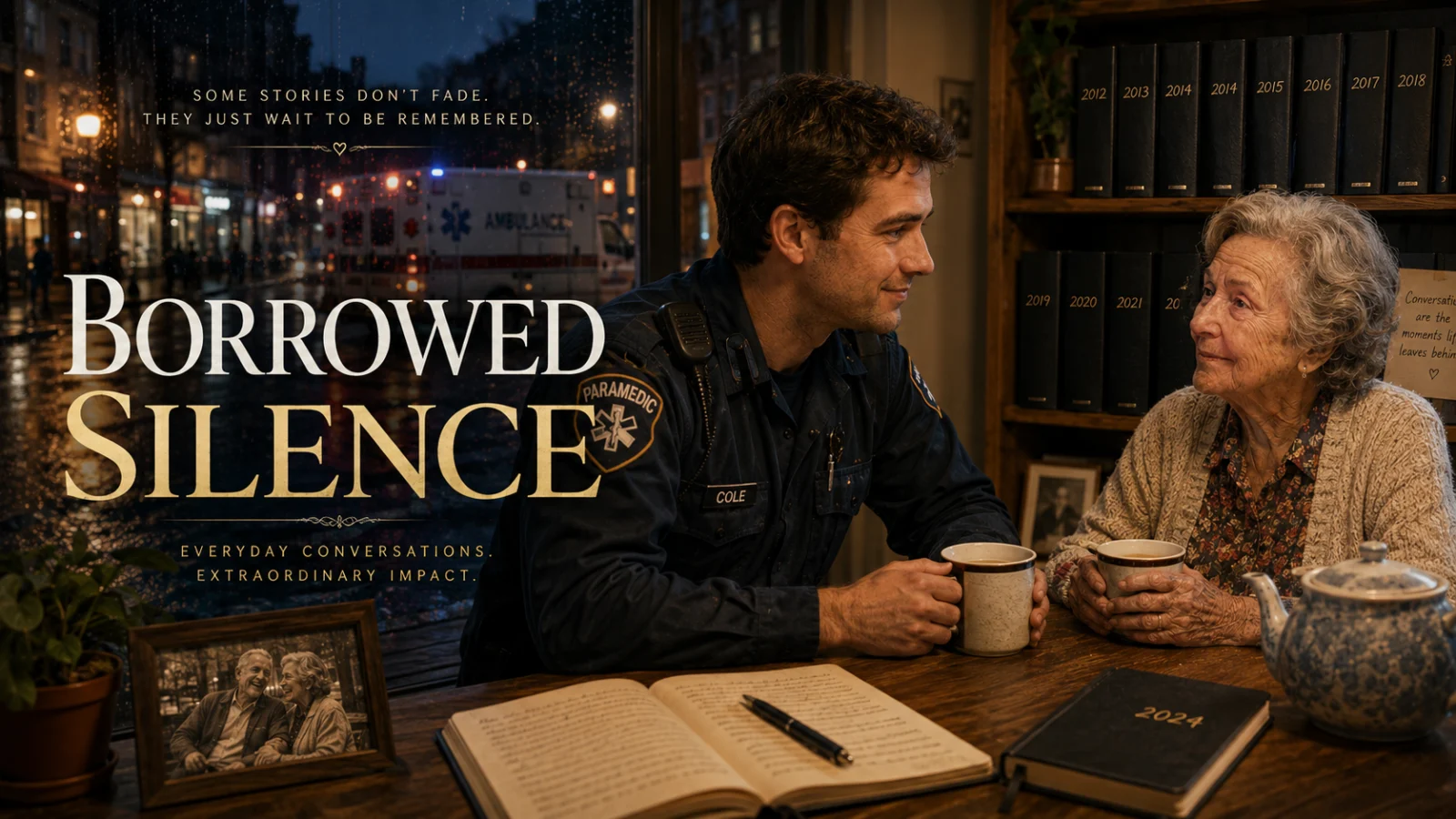
Ethan Cole turned off the kettle before he examined the woman on the kitchen floor.
Water had boiled through the spout and run beneath one burner. A broken teacup lay near her left hand. Ethan’s partner moved the larger pieces aside while Ethan checked the woman’s breathing, pulse, pupils, and the position of her legs.
“Eleanor Brooks,” she said. “I live here.”
“Do you know what happened, Ms. Brooks?”
“I reached for the kettle and slipped. I landed on this side.”
She tried to sit straighter and winced. Ethan asked her not to move yet. After fifteen years as a paramedic, he knew how often a patient who could joke through an assessment still had a fracture.
The apartment above Ashford Street was orderly without being bare. A mended curtain covered half the kitchen window. Family photographs shared a shelf with unopened mail and a ceramic bird. On the bookcase stood a row of identical black notebooks, each labeled with a year.
Eleanor followed his glance. “Those are notebooks.”
“I can see that.”
“Then leave them where they are.”
When Ethan and his partner helped her onto the stretcher, she kept one hand braced above her hip and told them exactly when the turn hurt. The X-rays later showed no break, only a severe bruise. The doctor prescribed medication and a walking aid, then asked whether someone could stay with her overnight.
“No one nearby,” Eleanor said.
She was discharged after Ethan’s shift ended. He saw her beneath the hospital awning, sitting beside a plastic bag that contained her folded coat and the walking aid instructions. Taxis stopped farther down the curb. Eleanor made no move toward them.
“Are you waiting for somebody?” he asked.
“The taxi came once,” she said. “I sent it away.”
“Do you want me to call another?”
“In a few minutes. I don’t want to go back yet.”
Ethan bought two hot chocolates from a vending counter. He left one on the bench between them rather than handing it to her. Eleanor checked the label on her medication before drinking.
Her husband, Arthur, had died twelve years earlier. He had talked to cashiers, neighbors, strangers in queues, and people who had already begun walking away. The first Christmas without him, Eleanor tried to remember the last joke he had told. She could recall where he stood and how hard she laughed, but not the words.
“So you started the notebooks,” Ethan said.
“I started one. The others accumulated.”
“Conversations?”
“Parts of them. Whatever I could remember afterward.”
She recorded arguments with pharmacists, questions from delivery drivers, remarks at the grocery store, and things neighbors said in the hall. Some entries were two lines. Others ran for pages.
“Does writing them make the apartment less quiet?” Ethan asked.
“No,” Eleanor said. “It is still quiet when I finish.”
Her taxi arrived. Ethan checked that she could get into the back seat with the walking aid. Eleanor thanked him for waiting, then asked the driver to take Ashford rather than the faster road because the faster road had potholes.
Eight days later, Ethan parked across from the bakery below Apartment 3B. He bought two cinnamon rolls, climbed the stairs, and knocked before he could replace the visit with a better idea.
Eleanor opened the door but did not release the chain.
“Are you working?” she asked.
“No.”
“Did I request a follow-up visit?”
“No.”
He held up the paper bag. “I can leave these and go.”
Eleanor considered him through the narrow opening. “You can come in for twenty minutes. No examination. This is one visit.”
In daylight he could see pencil repairs on the window frame and crossword clues spread across the dining table. The photograph beside the ceramic bird showed Eleanor and Arthur with a station wagon. Eleanor placed the cinnamon rolls on two plates, then removed one black notebook from the shelf herself.
“This year only,” she said. “And not the folded page.”
The entries were not transcripts. Eleanor shortened some speakers to initials and crossed out sentences she later disputed. A baker complained about burned rolls. A boy at a bus stop insisted that pigeons nodded when they agreed. A cashier asked about roses Eleanor no longer grew.
Ethan found his name halfway through. Eleanor had described the broken cup, the ambulance, and the hospital awning. A later note recorded their disagreement about pineapple on pizza and marked Ethan’s position `Wrong`.
“You didn’t write the whole conversation,” he said.
“I never do.”
After about half an hour, Eleanor said she needed to take her medication and rest. Before leaving, Ethan took the plates to the sink. She asked him to leave them there.
He did not return the next week. Later, after a call ended nearby, he brought tomatoes and bread. His visits remained irregular. Sometimes Eleanor let him in; once she said she was tired and did not open the chain.
Other visits had their own beginnings. Mrs. Alvarez from downstairs asked to borrow a novel and returned it with three pages bent. Eleanor objected. Mrs. Alvarez came back to defend her treatment of books, stayed for tea, and later borrowed another.
The bakery owner brought up a loaf near closing time and noticed the loose hinge on a cabinet. He returned with a screwdriver because the crooked door bothered him. The mail carrier sometimes stopped after finishing the third floor, but on heavy-delivery days he handed over the post and left.
They left when their errands, deliveries, or conversations were finished. There were evenings when Eleanor ate alone and wrote nothing.
One afternoon Ethan found Mrs. Alvarez’s grandson at the dining table with a school essay. Eleanor held a green pen above a sentence and asked him to read it aloud again. The baker was tightening the cabinet hinge. Flowers stood near the window in a drinking glass because the only vase Eleanor could find was too short.
Ethan put the bread on the counter. Mrs. Alvarez moved a chair so he could pass and continued looking for the book she had come to return.
Several months after the fall, Ethan saw Ashford Street on the dispatch screen again. The report said chest pain.
Eleanor was sitting upright when he entered 3B, one hand pressed below her collarbone. Her breathing broke the sentences she tried to make. She recognized Ethan, pointed at the rainwater from his boots, and stopped speaking while he placed the monitor leads.
At the hospital, doctors stabilized her and explained that her heart had weakened considerably. Medication could slow the decline but could not reverse it. Ethan heard the explanation as a paramedic, not as a relative, and still had no useful answer when Eleanor asked how much time `slow` meant.
Mrs. Alvarez came most afternoons, though she sometimes left before Eleanor woke. The bakery owner arrived with a paper bag and was told that food from outside had to remain closed. Former students came after learning she was there. Some visits lasted only a few minutes because Eleanor tired easily.
On Ethan’s last visit, she handed him the newest black notebook. Only a few pages at the back were empty.
“Take it for now,” she said. “Afterward, put it back on my shelf.”
“Why this one?”
Eleanor adjusted the blanket over her knees. “That’s where it goes.”
“Do you want me to give it to anyone?”
“I told you what I want.”
Ethan put the notebook in his work bag without opening it.
Three mornings later, Mrs. Alvarez called the ambulance station before sunrise. Eleanor had died peacefully before the crew arrived.
After the funeral, Ethan helped box the apartment. A distant relative collected most of the black notebooks along with the photographs and several cartons of papers. Once the packing was finished, Ethan returned the final volume to the shelf as Eleanor had instructed. He did not read the remaining entries. He locked the apartment behind him.
Winter passed before a young couple moved into 3B with their six-year-old son.
Several weeks later, Ethan stopped at the bakery. Mrs. Alvarez saw him through the window and asked him to carry a towel-wrapped loaf upstairs. At 3B she knocked, and the boy’s mother called for them to come in. Ethan set the loaf just inside the doorway and remained in the hall.
Cardboard boxes still occupied one wall. The boy sat on the floor with the last black notebook open across his knees.
“Who wrote this?” he asked his mother.
“I don’t know,” she said. “Maybe we’ll find out.” She closed it and put it on the table.
Mrs. Alvarez entered with the loaf. The bakery owner came up behind Ethan carrying a paper bag and waited for room in the doorway.
From the kitchen, a kettle began to whistle. The boy’s mother stepped around an unopened box and went to turn off the burner.