After-Hours Patient
Daniel Hayes stopped answering calls from the Maple Avenue clinic on the morning he removed its sign. The screws had rusted into the frame, and the lower corner caught against the brick as he pulled. He worked at it until the sign came free, carried it inside, and left it facedown in the reception area.
For twenty-eight years, people had brought him animals that limped, bit, hid beneath chairs, or became suddenly quiet. He had treated puppies while children watched from the floor and helped families decide when an old animal had reached the end of what medicine could offer. The work had never been easy, but its difficulty had once made sense to him.
After Emily died, the rooms became harder to enter. Her handwriting remained on old appointment cards. Her chair stood beside the desk where she had reorganized schedules whenever Daniel ran late. In the small kitchen, he still opened the cabinet where she used to keep the containers for his lunch.
He told people he was retiring. It was shorter than explaining that the clinic had belonged to a life he no longer knew how to continue.
Daniel moved to a small house near the edge of Willow Creek. He watered the garden, repaired old furniture, and read books he had bought years earlier. Neighbors invited him to dinner. He thanked them and found reasons not to go. Solitude required a decision; most of his days required only that he fail to answer the phone.
One November evening, wind pushed rain against the windows hard enough to drown out the television. Daniel heard scratching near the back door, stopped the program, and waited. The sound came again—three uneven scrapes, then silence.
He took a flashlight outside. A golden retriever lay close to the garage wall, soaked through and holding one front leg away from the ground. When Daniel approached, the dog tried to rise, failed, and watched him without growling.
“Don’t make this difficult,” Daniel said.
The dog did not have the energy to make it anything else.
Daniel carried him inside on an old blanket. He dried the coat enough to see the leg, cleaned the wound, checked for other injuries, and set water within reach. The dog drank too quickly, coughed, and tried again. Daniel moved the bowl away, waited, and returned it in smaller amounts.
The sequence came back without invitation: observe, stabilize, check again. For several hours, Daniel did not think about whether he still considered himself a veterinarian. An injured animal was in his kitchen, and the animal needed the person who knew what to do.
By morning, the retriever could stand briefly. There was no identification chip. An old leather collar circled his neck, but most of the metal tag had been scratched blank. Only one word remained.
“Charlie?” Daniel said.
The dog’s ears moved before his head did.
Daniel intended to take him to the shelter. It was the responsible next step, and responsibility was easier when it came with a known address. Before leaving, he examined the collar once more and found a narrow pocket worked into the leather.
Inside was an old photograph. It showed a young woman beside a much younger Charlie, with one hand holding a small boy’s. On the back, someone had written, `Charlie stayed when I needed someone most.`
Daniel read it twice. The sentence did not identify anyone or explain how the dog had reached Willow Creek. It did give him something more useful than a damaged tag: an image other people might recognize.
He posted the photograph online, contacted local animal groups, and checked old records. Then he waited. Charlie slept beside the fireplace, woke whenever Daniel crossed the room, and refused food unless the bowl was placed close enough that he did not have to stand.
Three days later, a woman called.
“Do you still have a golden retriever?”
Daniel looked toward the fireplace. “Yes.”
The caller went quiet. When she spoke again, she said, “His name is Charlie.”
Margaret Lewis lived in a retirement community twenty miles away. Daniel brought Charlie there on a blanket across the back seat. The dog was alert before the car stopped. When Margaret appeared near the entrance, leaning on a walking cane, Charlie pulled against Daniel’s grip for the first time.
Margaret dropped the cane and lowered herself carefully. Charlie reached her with an uneven gait and pressed his head against her chest. She held the collar with both hands until a staff member brought the cane back.
Inside, Margaret explained that Charlie had belonged to her and her husband, Thomas. After Thomas died, the dog had been the reason she went outside each morning and the presence that made evenings less empty. During a family visit two years earlier, someone left a gate open. Charlie disappeared.
Margaret had called shelters, posted flyers, and driven through neighborhoods. Eventually, the calls stopped producing new places to look. She kept his photograph in her wallet.
Daniel examined Charlie’s leg again and explained what to watch for. Margaret listened, asked him to repeat the instructions, and wrote them on the back of an envelope.
“How did he get all the way to your house?” she asked.
“I don’t know.”
Margaret ran one hand over the dog’s wet-weather-roughened collar. “Maybe he knew someone else needed him.”
Daniel looked at Charlie, who had begun investigating a paper bag beside Margaret’s chair. “He knew someone had food,” he said.
Margaret laughed. She did not insist on the other explanation.
A few weeks later, she invited Daniel to visit the retirement community. He almost declined. The invitation sounded social, and he had become skilled at avoiding social obligations. Margaret clarified that several residents had pets and questions they could not easily take elsewhere.
That gave the afternoon a purpose.
One resident wanted to know whether an older cat’s changed appetite justified a visit. Another needed help understanding instructions already provided for a dog’s medication. Daniel refused to diagnose what he could not properly examine. He checked the animals he could, answered what he knew, and wrote down what required follow-up elsewhere. Some residents struggled with cost. Others struggled with transportation or with holding a restless animal while reading small print.
Margaret stayed nearby with Charlie while one question led to another. Daniel found himself repeating instructions more slowly, turning labels toward the light, and separating urgent concerns from the ones that could wait. None of it was unusual veterinary work. What was unusual was how difficult ordinary work had seemed from behind a locked clinic door.
By the end of the visit, Daniel was tired in a way he recognized. He had also made a list—supplies, records, questions, limits—without noticing when he began it.
The next morning, he drove to Maple Avenue and unlocked the clinic. Dust had collected along the reception counter. The sign still lay facedown where he had left it.
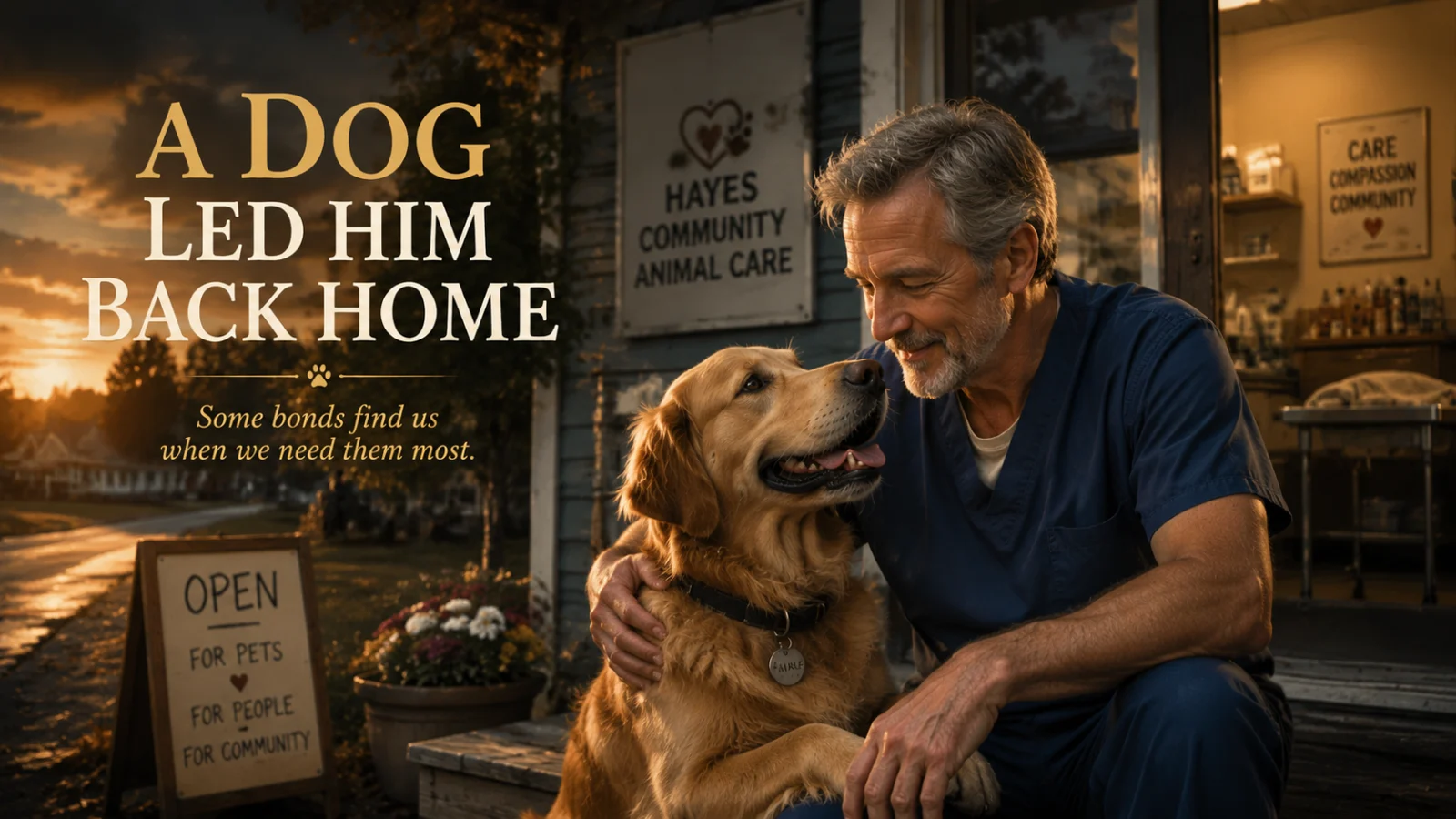
Daniel did not restore the old arrangement. The clinic reopened as Hayes Community Animal Care, intended for families who loved their animals but could not afford expensive treatment and for older residents who needed time and patience. Renaming it did not answer every question about how the work would continue. It gave him a door to open and a kind of patient to prepare for.
Near the entrance, he placed a photograph of Charlie sitting beside the clinic door.
Months later, while cleaning mud from Charlie’s collar, Daniel removed the old photograph from its pocket. A second piece of paper had been pressed flat behind it. The record was twenty years old and came from Daniel’s own clinic.
The handwriting was familiar. Thomas Lewis was listed as the owner. Charlie had been a puppy with a broken leg, and Daniel remembered a small boy crying because he believed the dog would never run again. Daniel had treated the leg for weeks. At the time, it had been one case among many.
He called Margaret.
“You were the person who helped him walk again?” she asked.
“Apparently.”
“And now he brought you back.”
Daniel turned the record over, checking for a note he might have missed. “He got lost. I found a record.”
“You can call it that.”
“I just did.”
Margaret laughed again. Daniel smiled, but he did not adopt her version. Chance did not become less useful because it was chance.
Charlie became familiar at the Willow Creek clinic. Children called him Doctor Charlie. Older residents brought treats Daniel had to ration, and muddy weather kept a towel near the front desk. Charlie slept through most appointments and became interested whenever packaging opened.
The clinic gave Daniel work, noise, invoices, unanswered questions, and animals whose needs did not wait for him to feel ready. It did not make Emily absent in a different way. On difficult mornings, he still reached for a second coffee cup before remembering there was no one to take it.
One stormy evening, Charlie lifted his head before Daniel heard the scratching at the back door. A soaked terrier stood beneath the outside light, its collar twisted and one paw held above the ground.
Daniel looked at the clock, then at Charlie. He reached for the towel by the front desk.
“All right,” he said. “You can help me with this one.”