Ruth’s List of Names
Nobody on Maple Street accused Owen Carter of stealing money. In some ways, that made the distance harder to answer.
Fifteen years earlier, Owen had persuaded several neighbors to invest in a housing development outside town. He believed in it enough to put in most of his own retirement savings. The developer disappeared before construction properly began, the bank seized the land, and by Christmas everyone involved had lost money they could not replace.
Owen stayed in the same narrow brick house. He mowed on Saturdays, cleared the sidewalk in winter, and brought in his trash cans before dark. The neighborhood did not force him out. Invitations stopped, and porch conversations became nods from a distance. Frank Dorsey, who had lost almost forty thousand dollars, stopped speaking to him entirely.
At sixty-three, Owen worked evenings at the town library. His official job was circulation assistant, though he spent much of his time repairing damaged books in a small room beside the boiler closet. He patched torn pages, tightened bindings, and scraped dried glue from old covers.
A split spine presented a visible problem. A loose page had a correct position. Nobody asked a damaged book what it should have known before the damage occurred.
Ruth Ellison became familiar because she complained about tape. One Thursday, she returned a gardening book with a cracked spine and tapped the repair Owen had made the previous month.
“That shiny kind peels. You should use cloth tape.”
“We do.”
Ruth pointed at the cover. “Not on this one.”
When Owen checked, she was right.
Ruth was eighty-one, short and square-shouldered, with silver hair cut unevenly around her ears. She carried the same faded grocery bag each week and borrowed gardening books despite living in a second-floor apartment with no garden.
“Why gardening?” Owen asked once.
“I used to have one.” Ruth adjusted the bag strap. “That’s enough reason.”
Over the next year, she became part of his Thursday routine. Sometimes she remembered Owen’s name. Sometimes she called him Arthur, the name of her late husband, and became annoyed when corrected. She once returned a cookbook the library did not own and insisted it belonged beside the gardening books. Yet she could identify tomato varieties from photographs and explain why certain hydrangeas should not be planted beside walnut trees.
Her memory did not fail in a way that made narrative sense.
One rainy October evening, Ruth left her bag beneath a reading table. Owen found it after closing, when the bus stop was empty and rain had blackened the pavement under the streetlights. He opened the bag only far enough to look for identification.
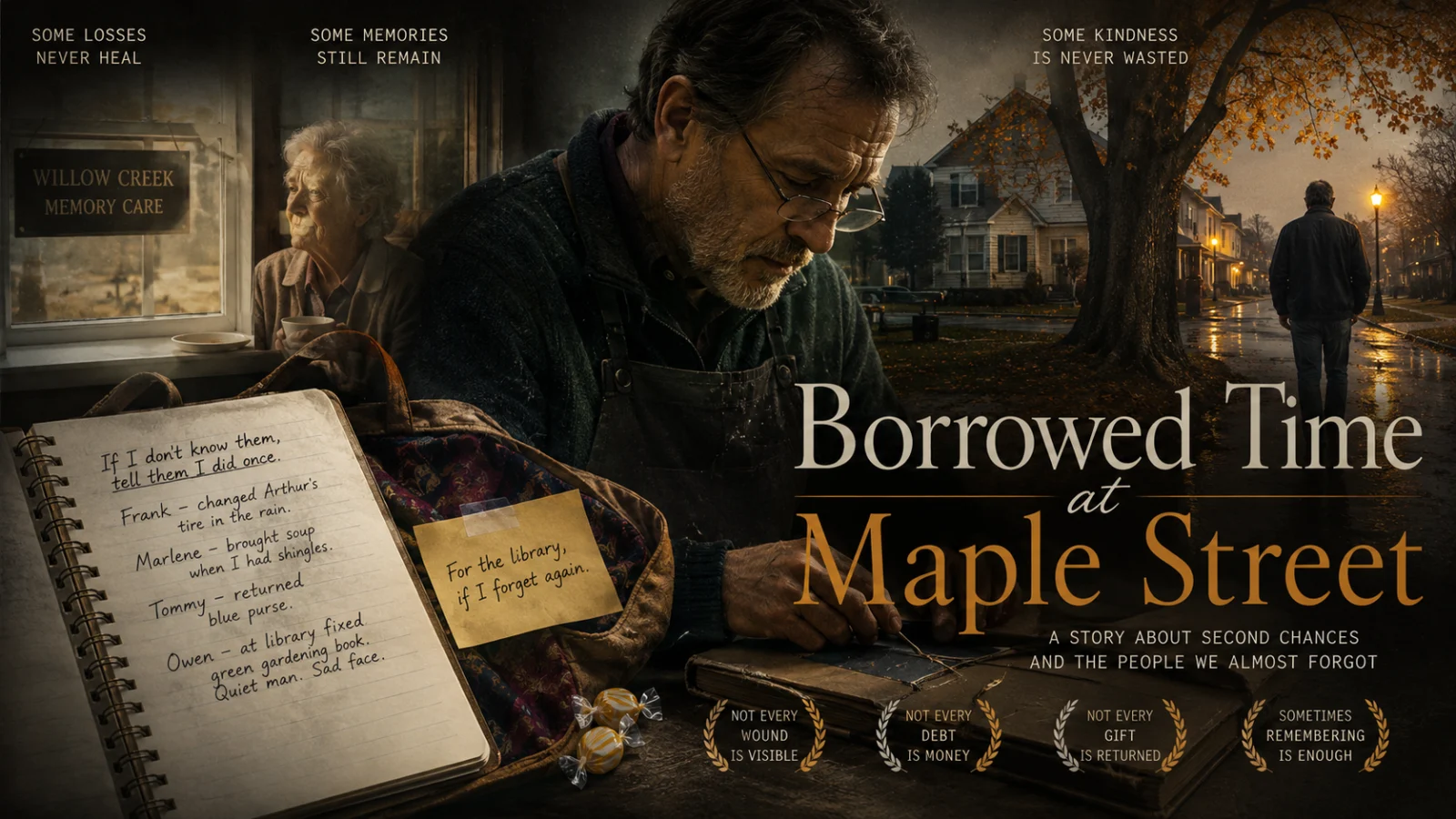
Inside were a cardigan, grocery coupons, two hard candies, a crossword puzzle, and a spiral notebook held shut with a rubber band. An envelope was tucked into the cover. Across it, Ruth had written, `For the library, if I forget again.`
The note inside said the notebook contained names she did not want lost.
The first pages resembled reminders: Frank Dorsey, Marlene Pike, Mrs. Alvarez from number eighteen, Tommy from the grocery store. Beside each name, Ruth had written fragments. Frank changed Arthur’s tire in the rain and refused payment. Marlene brought soup when Ruth had shingles and used too much pepper. A grocery-store boy ran after a bus to return Ruth’s blue purse.
Then Owen found himself: `Owen at library fixed green gardening book. Didn’t make me pay. Quiet man. Sad face.`
He read the entry twice. Several others contradicted themselves. Ruth wrote that Marlene had three sons and later changed the number to two. One woman appeared as `the lady with the loud dog`, followed in darker ink by `dog died, not loud anymore.`
On the final page, Ruth had written, `If I don’t know them, tell them I did once.`
Owen closed the notebook and returned everything to the bag as he had found it.
Ruth did not come the next Thursday. When she was absent the week after that, Owen used the number on her library account and reached her son, Daniel.
Ruth had moved to Willow Creek Memory Care after walking out of her apartment before sunrise. A police officer found her several blocks away carrying a flowerpot and looking for a house she had sold eighteen years earlier.
Daniel collected the bag on Saturday. He was in his fifties and wore paint-stained work trousers with a plumbing-company jacket. He turned several notebook pages and sighed.
“She wrote things everywhere. Receipts, napkins, envelopes. Names, things they did. Sometimes things they never did.”
He mentioned Ruth thanking his accountant neighbor for delivering twins. Then he pushed the notebook back across the counter.
“You can keep it if you want. She probably won’t remember it.”
The sentence stayed with Owen longer than Daniel intended. The following Thursday, he drove to Willow Creek.
Ruth sat beside a window with untouched tea. She studied Owen politely until he added, “Library.”
“Do I owe you money?”
“No.”
She looked relieved.
Owen showed her the notebook. Ruth read an entry about Mrs. Alvarez and frowned.
“She never made apple pie.”
“You wrote it.”
Ruth handed the book back. “Then I was wrong.”
They spent nearly an hour discussing tomatoes, buses, and whether Willow Creek had once been a school. Before leaving, Owen asked what she wanted done with the names.
Ruth looked toward the rain. “What names?”
A nurse arrived with her medication before Owen answered.
The first note he delivered belonged to Marlene Pike, who lived three houses away. Owen brought a photocopy of Ruth’s memory about pepper-heavy soup. Marlene read it on the porch.
“She remembered that?”
“Apparently.”
Marlene laughed at the pepper, then looked at Owen. “Don’t turn this into some redemption project.”
“I’m not.”
“Good. Ruth forgetting things doesn’t mean the rest of us did.”
“I know.”
“You always say that.”
She took the copy. Before closing the door, she told him Ruth liked the cheap lemon cookies from Bell’s. Owen brought a packet the next Thursday. Ruth ate two and complained they were too sweet.
Owen delivered the notes slowly. A retired bus driver received a memory about waiting while Ruth searched for a lost glove. A former cashier received the story of the returned purse. Leon discovered that Ruth had confused him with his dead brother, but folded the page and kept it. One woman refused her copy without reading it.
The refusals did not violate Ruth’s instruction. They exposed what the instruction could not decide.
Frank nearly closed the door when Owen appeared. Owen said the note was from Ruth. Frank said he did not care, and Owen turned away.
“What did she write?” Frank called after him.
Ruth remembered Frank changing Arthur’s tire in a storm and ruining a pair of shoes. Frank read the copy and snorted.
“Those shoes were already ruined.”
Owen nodded. Neither man mentioned the development. Wind rattled the loose metal number beside Frank’s porch.
Several weeks later, Frank came to the library with an old cardboard file box. It contained development contracts, bank notices, attorney letters, and photocopies of checks. He pulled out a statement showing how much Owen had invested.
“I thought you got your money out before everything collapsed.”
“I didn’t.”
“Why didn’t you tell us?”
Owen looked at the statement. “Would it have changed anything?”
Frank said maybe. Owen shook his head.
“I told people it was safe. It wasn’t. Losing my money doesn’t make that better.”
Frank leaned against the counter. “My wife blamed me for signing until the day she died.”
Owen lowered his eyes. “I know.”
“No, you don’t.”
Owen did not argue. Frank left the file box at the library.
By winter, Daniel had brought two more notebooks from Ruth’s apartment. They contained repeated names, wrong dates, and unfinished sentences. Owen kept them in a drawer behind the circulation desk. He did not make a display or announce a project.
Occasionally, someone asked whether Ruth had written about them. Marlene found no entry for her husband and tried to hide her disappointment behind `Typical Ruth.` Frank found an entry about an argument with a mailman and said he preferred the tire. Owen reminded him the tire was in the other notebook.
By February, Ruth no longer recognized Owen at all. He still visited every second Thursday. Some days she talked continuously; other days she slept. Once she accused him of stealing her gloves while wearing them. Another afternoon, she asked whether Arthur waited outside. Owen said he was not sure. He had stopped correcting everything.
Spring arrived late. Snow remained in gray piles along Maple Street until nearly April, and the library roof began leaking above the history shelves. Owen spent two evenings moving books into plastic crates.
One Thursday, Sophie, a teenage volunteer, carried a damaged gardening book into the repair room. Its spine had split, and several pages had swollen from water.
“This one looks finished,” she said.
Owen examined it. For a moment, it reminded him of the green gardening book Ruth used to borrow, though it was not the same copy. He began removing the old adhesive.
“You always try to fix them?” Sophie asked.
“Usually.”
“Even when they’re this bad?”
“Depends.”
Sophie waited. “That’s not really an answer.”
“No.” Owen kept working.
Near closing time, rain struck the basement windows. Frank appeared upstairs with two coffees and set one beside Owen.
“Decaf,” he said. “You look old.”
“You’re older than me.”
“By eleven months.”
Sophie laughed from the next aisle. Frank looked at the damaged book spread across the table.
“Worth saving?”
Owen aligned the loose pages, pressed the spine between two boards, and tightened the clamp.
“Ask me tomorrow.”
Frank pulled over a chair. “Fine.”
Owen wiped a thin line of glue from the cover. Outside, rain ran along the curb beneath the maple trees. Somewhere upstairs, Sophie dropped a book, swore quietly, and picked it up before either man could say anything.